Overview
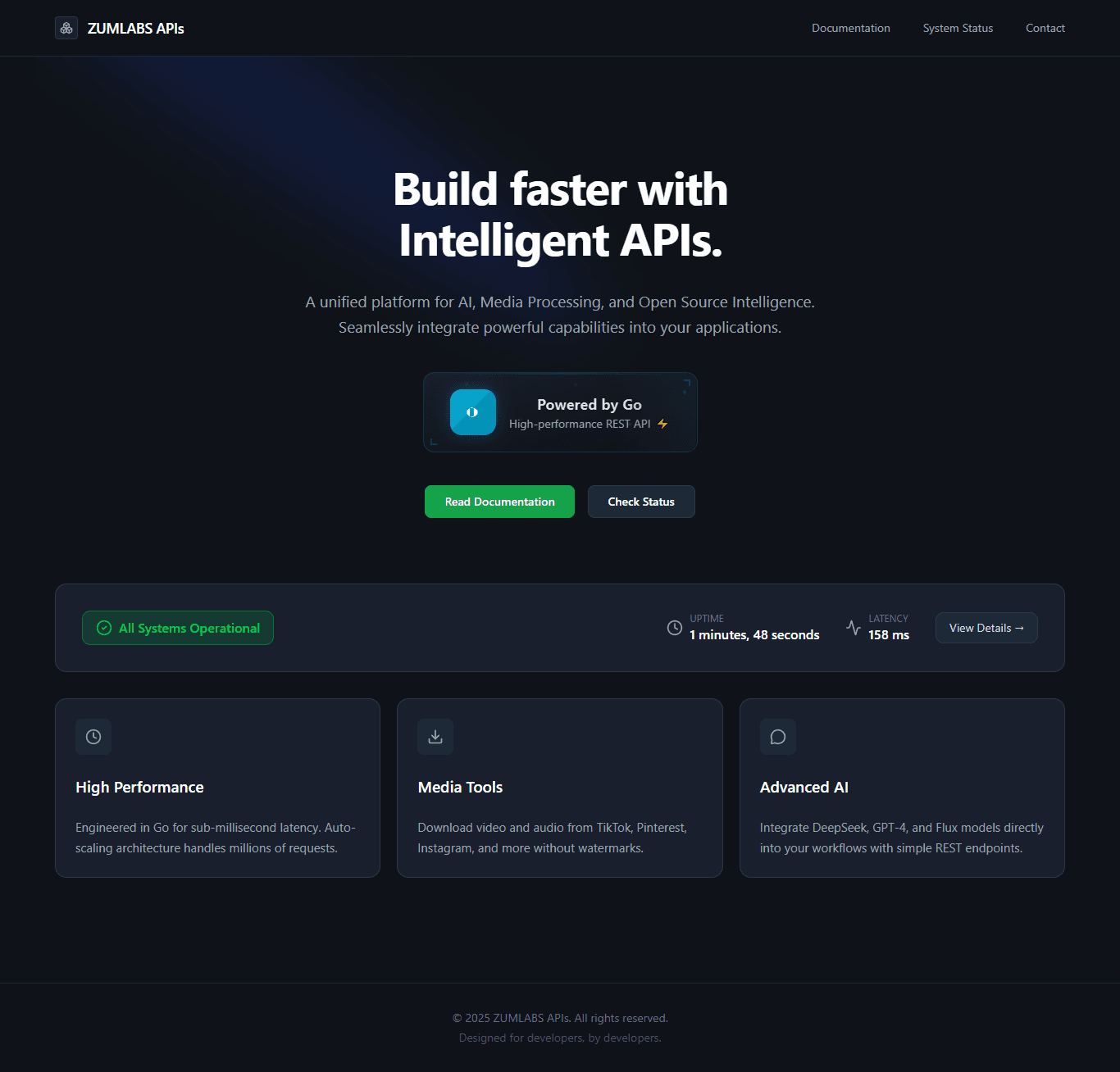
A comprehensive multi-service API platform that provides unified access to various services including AI capabilities, media processing, and third-party integrations. Built with a modern tech stack featuring Go for the backend and Next.js for the frontend, this project showcases enterprise-level API development practices with scalability and security in mind.
Purpose
The project aims to:
- Provide unified API gateway for multiple service integrations
- Demonstrate robust, scalable API architecture with security best practices
- Showcase modern full-stack development with Go and Next.js
- Offer clean, well-documented API interfaces for developers
- Support easy addition of new API services and endpoints
Tech Stack
This project leverages modern technologies across the stack:
Backend
- Go - High-performance backend with efficient concurrency
- Fiber Framework - Express-inspired web framework for Go
- Third-party APIs - AI services, media platforms, and more
- Docker - Containerization for deployment
Frontend
- Next.js 15 - React framework with App Router
- TypeScript - Type-safe development
- Tailwind CSS - Modern styling framework
- Shadcn/ui - Beautiful UI components
Features
Available API Services
-
AI Integration (GPT-4)
- Text generation and completion
- Configurable model parameters
- Streaming responses support
- AI-specific rate limiting
-
TikTok Media Services
- Video content retrieval
- No watermark download
- Metadata extraction
- High-quality media serving
Infrastructure
-
Rate Limiting
- Per-endpoint rate limits
- AI-specific limiting to prevent abuse
- Configurable thresholds
-
Middleware Stack
- CORS configuration
- Request logging
- Health check endpoints
- Error handling
-
Configuration Management
- YAML-based configuration
- Environment-specific settings
- Secure API key management
Frontend Features
-
Interactive Documentation
- API endpoint explorer
- Request/response examples
- Real-time API testing
- Code snippets for multiple languages
-
Status Dashboard
- Service health monitoring
- API status indicators
- Response time tracking
-
Modern UI/UX
- Responsive design
- Dark mode support
- Clean, developer-friendly interface
Architecture
The project follows a clean architecture pattern:
Backend (Go)
├── cmd/api/          # Application entry point
├── internal/
│   ├── config/       # Configuration management
│   ├── handler/      # HTTP handlers
│   ├── middleware/   # Custom middleware
│   ├── models/       # Data models
│   ├── service/      # Business logic
│   └── router/       # Route definitions

Frontend (Next.js)
├── src/
│   ├── app/          # App Router pages
│   ├── components/   # Reusable components
│   └── lib/          # Utilities
API Endpoints
Health Check
GET https://api.zumlabs.tech/v1/health
GET https://api.zumlabs.tech/v1/status
GET https://api.zumlabs.tech/v1/activity
AI Services
GET https://api.zumlabs.tech/v1/gpt4?prompt=your_prompt
Media Services
GET https://api.zumlabs.tech/v1/media/tiktok?url=tiktok_url
POST https://api.zumlabs.tech/v1/media/tiktok
Development Highlights
- Type Safety: Full TypeScript implementation on frontend
- Error Handling: Comprehensive error responses and logging
- Security: Rate limiting, CORS, and API key validation
- Documentation: Self-documenting API with interactive docs
- Deployment: Docker-ready with production configurations
Lessons Learned
Building this API platform provided valuable insights into:
- Designing scalable, modular API architectures
- Implementing effective rate limiting and security strategies
- Managing multiple third-party service integrations
- Creating developer-friendly documentation and interfaces
- Balancing performance, security, and maintainability
- Building extensible systems for easy service additions
Future Enhancements
Planned improvements include:
- WebSocket support for real-time features
- Expanded service integrations (payment, storage, communication, etc.)
- Advanced analytics and usage tracking dashboard
- API key management and user authentication system
- Webhook support for event notifications
- GraphQL API support alongside REST
- Automated API documentation generation
Links
- API Base URL: api.zumlabs.tech
- GitHub: github.com/zumlabs/apizumlabs
- API Documentation: api.zumlabs.tech/docs